
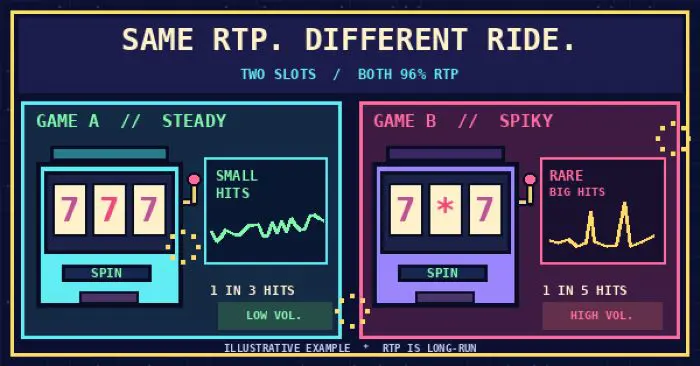
Many gamers have been watching a certain scenario unfold more frequently than I care to admit. For instance, a gamer will place bets on a Slot with a 96 percent return to player (RTP), play for twenty minutes, and leave with slightly more than he entered with after receiving a series of small wins. He will then load another 96 percent RTP Slot, lose his entire bankroll in fifteen minutes, and receive no substantial winnings. He will then contact me and wonder if the second Slot was tampered with or if the RTP number displayed is false.
Neither occurred. These Two slots have the same RTP and provide a complete opposite gaming experience. And once you understand the reasons why, the RTP number displayed on the Slot’s information screen means something much more specific — and thus much less encouraging — than most gamers perceive.
If you’ve ever asked yourself why slots with the same RTP seem to have a different “feel,” the simple explanation is that RTP simply provides an indication of how much a Slot pays back. However, RTP has absolutely no bearing on when or in what increments it may pay.
What RTP measures
RTP stands for return to player. A Slot machine that is identified as having a 96 percent RTP is developed so that it returns approximately 96 cents of every dollar placed as a wager over an extremely large number of spins. The remaining 4 cents represents the house advantage. This is essentially the only thing it is – a long-term average embedded within the Slot game mathematical model by the developer of the game, and tested in labs such as GLI, iTech Labs, or eCOGRA prior to release to a regulatory body such as the UK Gambling Commission or Malta Gaming Authority.
Again, we reference the phrase “extremely large number of spins.” Laboratories test RTP over Hundreds of millions, and usually billions, of simulated spins since that is the level required for the law of large numbers to apply and for the actual return to settle close to the theoretical return. However, your session(s) are obviously not that. An evening session could contain anywhere from 500 to 1,000 spins. At that level, the theoretical RTP is merely a faint background hum. Everything else is what you will actually perceive.
Also, there is a great deal that should be known about Slot RTP – including the fact that many slots are released at multiple RTP levels. A vendor may release the same title at 96%, 94%, and possibly lower RTP levels. Each version contains exactly the same artwork, audio, and branding. The variation lies solely in the mathematics employed in each version.
Therefore, before you even begin to discuss volatility, please verify the RTP as provided via the RTP display located on the Slot itself versus relying on a review website’s claim regarding that RTP.
In-game RTP displays vs headline figures:
I have personally experienced discrepancies between the display located within the game itself and what i refer to as the “headline figure” as published on websites more often than i would have anticipated.
What RTP leaves out
RTP is similar to a budget. The total amount available for return to the player in any given game is determined based upon RTP. The designer of the Slot determines how that amount is distributed. The designer can distribute it evenly among numerous small wins. Conversely, the designer can save most of the potential return for One massive bonus win. The designer can also determine how to allocate the return between a base game and/or free spins bonus round in virtually any manner desired.
Example illustrating why RTP does not indicate how frequently wins are paid:
For illustration purposes only, let us consider Two fictional examples:
1. Slot machine #a: pays 96 x your bet amount once per 100 spins
RTP = 96%
2. Slot machine #b: returns 0.96 x your bet amount on every single spin
RTP = 96%
As illustrated above, Slot machine #a will pay only once every hundred spins and will feel like a wasteland broken up by infrequent fireworks. Conversely, Slot machine #b will pay on every spin; however, since each spin produces a loss (due to the 0.04 x your bet amount being subtracted from each win), Slot machine #b “wins” 100% of the time and loses 100% of the time due to its payout structure.
While neither example illustrates a realistic Slot machine game, every real-world Slot machine exists somewhere along a continuum between Slot machines #a and #b. The position of a particular Slot machine on this continuum greatly influences how players view and interact with that game compared to other games with identical RTP values.
Continuum defined by three variables
There are fundamentally three variables defining this continuum:
1) volatility: shape of wins
Slot machines exhibit varying degrees of volatility; i.e., how uneven are payouts?
Technically speaking, it refers to the degree of dispersion surrounding an average result. In layman terms, it is how bumpy the ride.
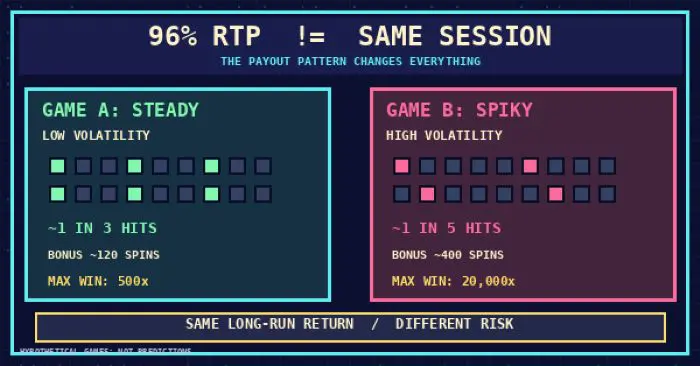
Low-volatility slots typically deliver small wins often. Thus, your bankroll may fluctuate during gameplay but it is unlikely to crash precipitously. High-volatility slots deliver large wins infrequently. Therefore, your bankroll tends to dwindle slowly until your account balance experiences sudden spikes upward. Medium-volatility slots exist between low and high volatility; i.e., it is where many mid-range mainstream Slot titles fall.
To provide approximate representations regarding RTP vs Variance: using $1-per-spin betting for a fifty-spins (twenty-five minutes) session at a table game using slots at $1-per-spin. Over an extended period (in theory) you expect to lose 20 dollars due to house-edge from $500 in wagering on any game labeled at 96% RTP. With respect to volatility, low-volatility games have relatively modest swings in regards to your bankroll; e.g., plus/minus $80-$100 around that $20 loss. With respect to high-volatility games, there is a significantly larger swing; e.g., +$400/-$300 loss/gain in your bankroll during that session. While those were hypothetical numbers used strictly for illustrative purposes, they represent accurately: same expected loss / wildly divergent short-term swings.
That represents the essence of RTP vs volatility. Volatility defines the size of the target while RTP defines the location of the center-point of that target.
Hit frequency: how often anything happens
Slot hit-frequency relates directly to how often any combination of winning symbols appears on the reels resulting in a payout. It seems intuitive (i.e., misleading) for people to confuse this variable with volatility. As stated previously, they are distinct variables.
Most modern video slots fall into a range of about 20%-35% hit-frequency although there are exceptions at both ends of this range and some developers choose not to publish hit-frequency data on their products. A game with a hit frequency of One-in-three (33%) feels active (busy). A game with a hit frequency of One-in-six (16%) has lengthy dead-splays; therefore you notice them.
Slippery slope
High-hit-frequencies are not always associated with low-volatility. A game can generate frequent hits while offering small base-game wins, therefore maintaining volatility while delivering significant bonuses and large swings.
Similarly, low-hit-frequencies can generate respectable sized wins when they do occur; thereby providing moderate volatility.
Bonus frequency & where the RTP lives
This section represents an area most gamers never investigate and honestly represents an area that best accounts for why two sessions on two same-RTP games can appear utterly dissimilar.
The primary factor responsible for the disparity is volatility; specifically, in regard to short-term results. Long-term expectations are affected primarily by the house edge, whereas short-term expectations are affected primarily by Variance. The house edge is an ongoing gradual process; whereas Variance is comprised of waves.
Match that to your bankroll: high-Variance slots require larger cushions than lower-Variance slots relative to your wager size
If you’re limited to $50 for your nightly gaming session and you’re going to wager $1 per spin on a high-Variance game, you’ll probably be finished before the first bonus round triggers. Reducing your wager size down to .20 cents per spin allows you to continue playing longer.
Lower-Variance games are generally more forgiving to smaller bankrolls & longer sessions although rarely provide the type of story people tell afterward
Set deposit limits/loss limits/session limits prior to gaming
Every licensed online casino provides these options. If you feel your gaming has stopped being fun; you can obtain free/confidential assistance from organizations such as GamCare & begambleaware.
FAQs
Do two slots have to have the same RTP?
Yes – and this occurs commonly. There are Hundreds of Slot titles at or near 96%.
Why do slots with identical RTP values seem to feel different?
Because RTP only represents total payback; all other factors determine payout distribution rate – e.g., how often you receive payouts; how large individual payouts are; etc.
Does having the same RTP represent having the same types of payouts?
No – Two games can return equivalent totals over millions/billions of spins but can deliver those payouts in vastly different forms and frequencies.
Does having the same RTP mean you will experience the same degree of volatility?
No – RTP & volatility are independent databases. A game can be both gentle and brutal @ 96% RTP.
Does having the same RTP mean you will experience the same level of hit–frequency?
No – again, RTP & hit-frequency are separate database entries – each title determines symbol distribution/paytable design which directly influences hit-frequency data
Will RTP influence the frequency at which a Slot generates payouts?
No – hit-frequency is designed into a Slot title independently from RTP values. RTP values define total potential paybacks available while hit-frequency defines number of times that value will be distributed.
Will volatility impact my expected RTP value?
No – volatility has no bearing on expected overall RTP value – it defines short-term deviation away from that expected value.